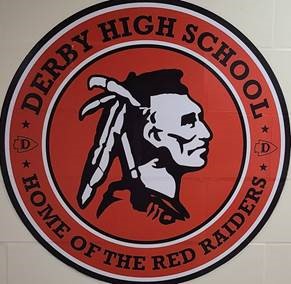
Photo from Go2Tutors.com: The Derby school community has different takes on the mascot. Is it offensive, or not?
By The Raider Press staff
“Respect our name,” says Chief Richard Velky, head of the Schaghticoke tribal nation (pronounced SKAT-i-kohk), which originated in the Derby area centuries before the state of Connecticut even existed. Does our school mascot, the Red Raider, respect Chief Velky’s tribe? This has been a question circulating amongst the Derby school community since the Board of Education re-approved the mascot last year. At the time, the state had made it a legal requirement that schools receive tribal support if they wanted to use a Native American mascot and continue to receive financial funding from tribal casino revenue. Derby received the approval it needed from the Schaghticoke tribe.
The acceptability of Native American mascots has been a question garnering national attention for years as well, so The Raider Press conducted an investigation through several interviews with local officials, including Chief Velky himself, along with research involving documents from Derby’s history. As the school’s journalistic staff, we hope to clarify a number of questions that have arisen about the school’s mascot. We hope that the information published here can help people make informed opinions of their own.
The Raider Press would love to hear how the Derby community feels about this issue. In response to this article, please send letters to the editor by emailing jyanes@derbyps.org or crice@derbyps.org.
What is the history of the ‘Red Raider’ mascot?

Photo by Azariah Smith ‘23: Native American imagery was used in the DHS yearbook as early as 1905.
Thanks to help from the Derby Public Library and the Derby Historical Association, we know that Derby High School’s Red Raider mascot was formally established in 1936. Although there has been Native American and arrowhead imagery used in DHS’s annual yearbooks since 1905, we learned from Bill Pucci, a former sports writer for the Sentinel Newspaper, that the Derby football team’s name prior to 1936 was the “Crimsons.”
That year, the Board of Aldermen in Derby invited the DHS football team to a Yale University vs. Colgate University football game at the Yale Bowl in New Haven. The mascot for Colgate’s team was the Red Raider, and Colgate’s uniforms closely resembled Derby football’s colors. The similarity gave the Derby team the idea for the official name “Red Raider.” (Interestingly, even though Colgate has kept the name “Red Raider,” the university later changed its signature image from a Native American to a white colonial settler.)
The Red Raider is now known to be a symbol of Derby. Jim Gildea, current chairman of Derby’s Board of Education, said, “I first got on the Board of Education in 1992 and it was the mascot then; it’s been the mascot for as long as I can remember, even since I was a child. I remember sneaking down the hill to get into football games as a young boy in the 1970s and that was the mascot then.”
Last year, Gildea played a major role in officially recommitting the district to the Red Raider mascot after a new Connecticut state law challenged it. The law requires that towns that use Native American names and images for mascots receive written support from a state or federally-recognized tribe in Connecticut, or risk losing state grants derived from revenue at the state’s two tribal casinos: Mohegan Sun and Foxwoods Resort. DHS was able to receive approval from the Schaghticoke tribe and therefore was able to keep the Red Raider name and mascot, along with over $200,000 from Connecticut’s casinos.
There is a longstanding historical precedent for Derby receiving mascot support from tribes. Before the Board of Education completely validated their vote to approve the original Red Raider mascot in 1936, they asked permission from local tribes such as the Pequot, the Housatonic, and the Paugussett in order to use the Red Raider name. The idea to ask for permission originated because at the 1936 Yale vs. Colgate football game, a Native American was seen roaming the Colgate sidelines.
As a result, when Derby needed renewed tribal support for the Red Raider mascot in 2022, Derby Public Schools superintendent Dr. Matthew Conway got into contact with Connecticut’s Schaghticoke tribe (SKAT-i-kohk), and that is when he began his connection with Chief Velky. Chief Velky had always supported the idea of our school using the mascot since he views the mascot as a sign of respect for his tribe. He said, “Respect [is] the bottom line. If we don’t have respect amongst each other, then you wouldn’t want anyone using anything you have.” Although he said he received some backlash from other tribes who “wrote to [him] and asked [him] not to support it,” the members of his tribe agreed with his support of Derby’s Red Raider mascot. Chief Velky, after getting approval from his tribal council, helped to write a formal resolution in support of the DHS mascot.
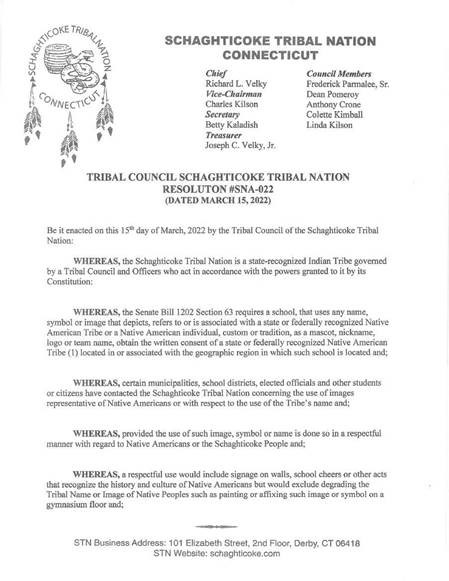
Image from Jim Gildea: A resolution from the Schaghticoke tribe allowed Derby to keep its mascot while still receiving tribal casino funding. The first page of the resolution is pictured here.
Conway first got into contact with Chief Velky because of the Schaghticoke’s connections to Derby. The tribe’s current territory includes an area in northwest Connecticut that is 35 miles long and 68,000 acres large that is still technically unclaimed land today. More specifically, the Schaghticoke tribe was based in Kent, Connecticut as early as 1736. Before that, they were based all along the Housatonic River, including in the Derby area. About his tribe’s original territory, Chief Velky stated, “We weren’t bound in the state of Connecticut; we also existed on the state of New York borderline. The research we have done shows that we actually were instrumental in changing the borderline between New York and Connecticut.”
The tribe is most known for its basket weaving and catching rattlesnakes. Back in the early 1900s, people from New York would even take the train to Kent just for rattlesnake hunting. Chief Velky explained that the tribe still deals with the rattlesnakes that they are known for: “They’re a big snake, and they can kill you, and you need to be careful if you’re ever in that territory.” The people of the Schaghticoke tribe would go up into the mountains to move the snakes so none of them would risk being bitten.
The Schaghticoke tribe has been tied to Connecticut before it was even a state, but Chief Velky was saddened and frustrated when he explained to the The Raider Press that around 1950, the state began bulldozing Schaghticoke homes. Before that, in 1903, the state built a dam bordering tribal property which flooded the burial sites. What’s more, Chief Velky explained that after the Schaghticoke tribe was granted federal recognition in the early 2000s (which allows tribes to receive helpful educational and healthcare resources, among other supports), the state of Connecticut managed to reverse the Bureau of Indian Affairs’ decision, stripping the tribe of its federally recognized status. Chief Velky said his tribe is one of only two tribes in history to get their federal recognition taken away once it had been granted.
Derby has the centuries-old Schaghticoke tribe to thank for its history and for giving us the opportunity to keep our mascot.
What does the mascot represent today?
“It is called the Schaghticoke tribe,” said Gildea in his interview with The Raider Press. The Schaghticoke tribe’s approval led to the decision to keep the DHS mascot. Their history “goes back to King Philip’s days,” according to Velky. “Our people settled in Kent in 1736. That’s when the tribe moved up from Derby into the Kent area. So our roots are very thick in the soil up there,” Velky said. The tribe has been around in Connecticut for centuries but is rarely acknowledged. Velky stated, “We have challenged the state in many avenues, in who we are, and what we were, and what was taken from us.”
Given the tribe’s difficult relationship with the state, how did the Schaghticoke tribe form a relationship with the Derby school system? According to Velky, the tribe’s official office has been in the town of Derby since 2003, “maybe even earlier.” They felt a lot stronger settling their office in Derby than in their former office location, Monroe, due to their centuries-long roots in this area. “We had quite a few people come from the valley that belong to the tribe,” Chief Velky said, such as his fifth grandfather, Joseph Mauwee, who had a connection with Derby for hundreds of years. In fact, the town of Derby used to be named after him. Due to the long-standing relationship with the town, Velky had gotten to know the former mayor, Anthony Staffieri. “We rented in the building that [Staffieri] owned at one time. So our relationship throughout the years started by supporting each other,” Velky stated. “Tony [Staffieri] and his brothers would throw their Schaghticoke shirts on and support us in the Hartford legislature. When the current mayor [Richard Dziekan] was elected, he came over to me and started a great relationship, and through the mayor, I met the superintendent.”
Since then, Chief Velky and the Schaghticoke tribe have had involvement in the Derby schools. For example, at the beginning of last year, the Native American head image was taken off the gym floor and replaced with the arrowhead at the request of Chief Velky and his tribe. While the Native American head remains displayed in other parts of the high school building, it was removed from the gym floor since it was seen as disrespectful for the image to be stepped on and walked over. Chief Velky’s involvement with Derby will continue as the district works on making local Native American history a larger part of school culture.
How do mascot laws connect to state and national trends?
Derby isn’t the only school that has questioned its choice of mascot. In early 2021, Geoff Luxenberg, State Representative for the 12th House District of the Connecticut House of Representatives (including Branford, Durham, Guilford, Killingworth, Madison and North Branford), proposed a bill that prohibits the use of Native American mascots in public schools. Later on, Kathy Osten, a Connecticut State Senator representing District 19 (including Columbia, Franklin, Hebron, Lebanon, Ledyard, Lisbon, Marlborough, Norwich, Sprague, and part of Montville), developed an alternative to that bill and introduced Senate Bill 502, Section 63, pictured below.
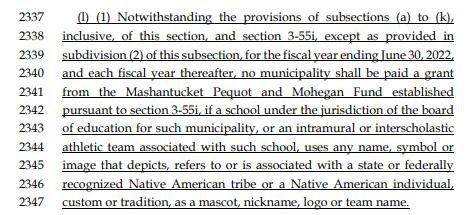
Image from Connecticut General Assembly, Bill No. 502: The language of the Connecticut bill requires schools to receive approval and support from a local Native American tribe if they wish to continue to receive funding from tribal casino grants.
The law states that any city that has a mascot or a name with a Native American background would be subject to losing the money that they received from the Native American casinos in the state; this money was up to $207,000 for Derby. Gildea explained the background behind where the money came from: “When casinos were first introduced to the state of Connecticut, there was a deal that the towns would get money from the casinos, Derby through the years was meant to get $207,000. When that law passed, we had to have some discussions about whether we were going to keep the mascot name and imagery for $207,000.” Ultimately, Derby High School decided to keep the mascot and was backed by the Schaghticoke tribe.
In 2021, there were 62 total school mascot and moniker changes in the US. There are schools that have decided to remove their mascot or not have a Native American themed mascot at all. For example, in Connecticut, Conard High School and William H. Hall High School, public schools in West Hartford, changed their mascots after a Board of Education meeting in February 2022. Conard High School changed from the Chieftains to the Red Wolves. Hall High School changed from Warriors to the Titans.
In contrast, other schools besides DHS have also been able to keep their mascots through a formal agreement with a tribal nation close to their location, even nationally. According to data collection by the National Congress of American Indians, who keep a national school mascot tracking database that was updated in November 2022, there are 1,911 schools and 970 school districts nationally that have themed Native American mascots. For example, there are 15 schools making up 8 districts in Oregon. Each of these school districts has a formal agreement with a tribal nation located in the state of Oregon after the requirements of Senate Bill 1509, which became law on March 10, 2014. The bill allows a district school board to enter into an approved written agreement with a federally recognized Native American tribe in Oregon for use of a mascot that represents, is associated with, or is significant to the tribe.
The issue has also applied to a span of national sports teams for decades. In 1969, the Philadelphia Warriors basketball team moved to San Francisco; they decided to drop the Native American logo in favor of the locally-known Golden Gate Bridge while keeping their name. In a more recent time, as of July 2021, the Cleveland Indians’ name was changed to the Cleveland Guardians. Another example of a recent name change is for the Washington Commanders. In 2020, the Washington Redskins changed their name to the Washington Football Team during the 2020 and 2021 seasons before adopting the name Washington Commanders in February 2022.
Nationally, some areas and teams trend towards changing their names and logos if they have a Native American theme, though this pattern does not apply everywhere.
Why do people support the mascot?
The majority of Derby seems to support the Red Raider mascot. Gildea said, “The people I talked to were happy. It wasn’t a controversial topic in town. It garnered very little attention. Nobody came to any board meetings to speak about it. I did get one or two emails, maybe three; it was not a topic that generated a lot of attention.” The Board of Education did not survey the community at large when making the decision about the mascot, but Gildea said he received emails from alumni who were in full support of the mascot. The Raider Press conducted a survey at DHS to gauge whether students and staff found the mascot offensive; of the 89 students and staff members who took the poll, 73% did not find the mascot offensive.
Robert Swierbitowicz, a business teacher and sports coach at DHS, elaborated on why he supports the mascot: “It has a huge history behind it and Derby needs to stay with the history, keep the history alive.” Student Kaelyn DiMartino ‘25 is also in full support of the mascot because of the rich history behind it. She told The Raider Press, “I support it because it gives so much meaning to this school and this town. It has a deep meaning and really brings the community together.”
Similarly, Chief Velky made it clear that he was in full support of the mascot and felt honored when he said, “It was a name you got to choose, and when you choose something that is a Native American name, it makes us proud that your forefathers had the foresight to choose that name and represent this part of our heritage.” Apart from Chief Velky being in full support of the mascot, all he asked was it be done with respect.
In fact, Chief Velky views any school decision to get rid of a Native American mascot as akin to further discrimination against Native Americans. In his words, “[Your logo] is an honor to us and the biggest dishonor you could give us is to do away with your logo, to do away with the name, then do away with me. If you keep erasing anything that has to do with any culture or any race, but in this case, Native Americans, then it’s just another way of discriminating against us and doing away with us.”
Other than Derby, there are many other schools that are in favor of Native American mascots. The University of Kansas argues that Native American mascots are used at the school because they are strong, courageous people and they are admired; in 2013, the Washington Post ran this letter to the editor from a reader who self-identified as a University of Kansas college graduate: “Teams choose Native Americans as mascots and role models because people admire these people. We view them as strong and courageous with many other positive qualities, not as negative stereotypes.” According to an Associated Press poll conducted at the University of Kansas, ”Nearly four in five Americans don’t think the team should change its name.” Only 11 percent think it should be changed, while 8 percent weren’t sure, and 2 percent didn’t answer. In 2013, “several poll respondents told the Associated Press that they did not consider the name offensive and cited the history behind the mascots and tradition in arguing that it shouldn’t change.”
Why do people oppose the mascot?
Not everyone is supportive, though. The primary reason that people oppose the Derby mascot, for example, is that they think it is racist, stereotypical, disrespectful, and offensive to Native Americans. Similarly, non-profit organization Teach For America publicly opposes the use of Native American mascots and supports their removal from K-12 schools, colleges, universities, and professional sports teams.
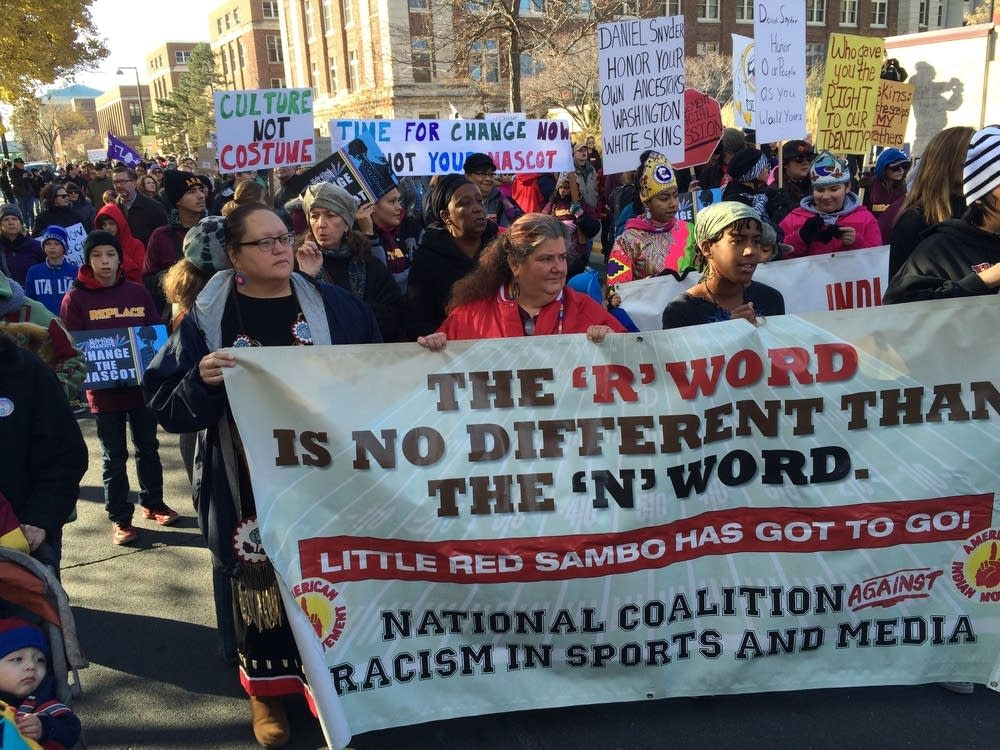
Photo from NPR: Many Indigenous rights support groups protest Native America mascots and imagery.
Some other districts in Connecticut also have struggled with this issue. When Chief Velky brought this issue to his tribe’s council, he said, “I told them it wasn’t just Derby, it was West Hartford, Watertown, New Milford, and one in New York that were also contacting us at the same time about the same issue.”
This is also a national sports team issue with teams such as the Kansas City Chiefs. Recently, right before the Kansas City Chiefs won the Super Bowl LVII in February of this year, there were protests and articles written against their name. Another well-known example is the former Washington Redskins, now known as the Washington Commanders, changing their name because they got a lot of backlash from all kinds of people who found it offensive.
According to some, certain names can be offensive and disrespectful. “Raider ”from DHS English teacher Kristin Parry’s perspective, “has a negative connotation. It’s a negative action,” and implies taking something, or people raiding a town in a violent way. In addition, she said “[the color red] is associated with the term Redskins, and I think there’s a connotation and association with the color red,” referring to the way that the term “Red” was formerly used as a derogatory name for a Native American person. Parry continued, “As we become more enlightened about truths from our past, I think it’s important that if we know better, we do better. If we know how to be more inclusive with language, then that’s something we should do.”
Similarly to Parry, Gianna Akter ‘25 said, “The term ‘Red Raider’ in connection with the mascot is definitely really racist because that was used as an insult and a slur throughout history, and some people get mad at that, and that’s just how it is.” Akter remarked on the difficulty of speaking up about this topic at a school where people hold strong opinions in favor of the mascot. For her, “Speaking up about it in school is scary because when you speak up people get mad at you for saying facts. Yes, the connection with the mascot is racist, and people get mad at you for saying that.”
Other students take the issue further. Jinayla Reyes ‘23 also takes offense to “The Powwow,” the addition to the annual DHS yearbook published each spring. Reyes explained, “The Powwow is a separate book in addition to our yearbook that gets published at the end of the year. We can’t add prom in our yearbook because it happens too late, so the Powwow allows events like that to be added to the yearbook.” Reyes sees the title of the Powwow as culturally appropriative (when one culture takes advantage of an aspect of another culture and uses it for their own benefit): “I don’t know if we have any Native American students here, but it’s cultural appropriation especially because that’s not what a powwow is. A powwow is what Native Americans do. They would gather around in a circle, they would listen to music and things like that, so it doesn’t fit with what our powwow is.”
Where do we go from here?
Teachers and students at DHS have mixed opinions about the school’s mascot, but there are many who see a strong benefit in making Native American history a larger part of the curriculum. Social studies teacher James Piazza says, “In my class, I make it a point to discuss indigenous cultures, especially in the Americas, and to fill in some gaps or correct some misinformation. “ He mentioned to The Raider Press that the school has a Native American history course elective, but he says there is plenty more the school can do with that curriculum. For example, Piazza “would love for our students to have the opportunity to speak with indigenous [people] or different Connecticut tribes to learn about the different cultures, customs, histories, stories, and their standpoints on issues concerning their communities.”
Students largely support bringing more Native American content into DHS’s curriculum, too. But most DHS students know little about the Schaghticoke tribe and what their ties are with Derby, even though some say the mascot brings that knowledge into the community. Knowledge about the Schaghticoke can certainly be deepened, so our district has begun creating a curriculum based on Native American history. Dr. Mike Rafferty, Director of Teaching and Learning for Derby Public Schools, is in charge of setting up the curriculum for the school district. Based on state guidelines, he decided to set up a course that will give kids information on the history of Native Americans. Similarly to the recently state-mandated course on Black and Latino studies, schools are now required to offer a Native American studies course. However, the course would be a voluntary elective; students are not required to take the class.
Rafferty said that the actual curriculum will not be available from the state until June, so in the meantime, Derby is working on gathering the information this course will need on local tribes. Rafferty thinks this will be a great addition to the curriculum because it will bring in more understanding of the school’s history and native culture. Rafferty says, “All history should be considered essential.” As for Native American mascots, Rafferty says, “I assume they will cover the concept of mascots in the curriculum, but I do not know how.”
Conway’s perspective on the new Native American curriculum is that “as it has been with any curriculum, it needs to come from the locality, and you need to bring that into the curriculum in order for students today to make that connection to the community.” Conway thinks “there’s a real sense of pride in that” and noted that studies show that when students study something about their community, there’s a greater engagement and interest that spirals from that for student learning. Conway said, “We really need to bring that authentic curriculum into our core.”
Chief Velky agreed with the sentiment of needing an authentic curriculum. “Until that can be at the very least given to you [in the right way], with the proper education on where Native Americans stand in the state of Connecticut, I wouldn’t mind once a year coming to the school and having a talk, or setting something up.” Conway, Velky, and Rafferty will continue to work on developing this curriculum so that it can be offered this coming school year.
As Velky says, “The only way to get a message out is to present it.”
 The Raider Press