
By Gianna Akter ’25
“He thinks of Ginny Fleming putting her hand on the barrel of his pistol, their love a graveyard where nothing stayed buried” (Lee 407).
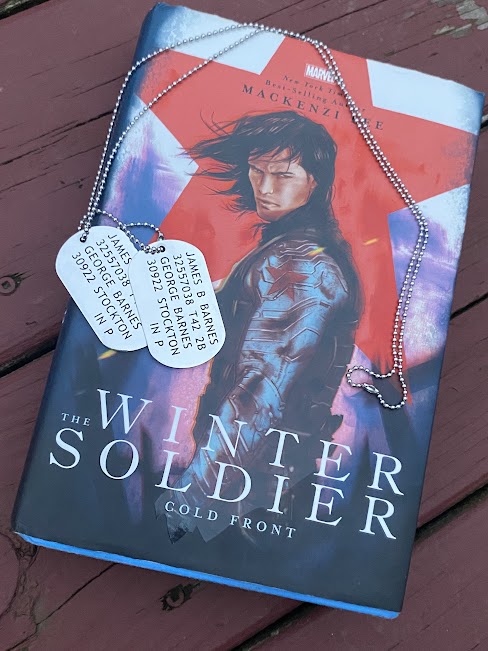
This quote comes from the heartwrenching young-adult novel The Winter Soldier: Cold Front by Mackenzi Lee, and summarizes the essential themes of the story: love and the necessity of human connection in people’s lives, especially in times of war and chaos. Two plots unfold simultaneously, following the storylines of both James “Bucky” Barnes and the Winter Soldier (code-named “V” or “Vronsky”), as the perspective shifts from 1941 to 1954 throughout the novel. Bucky and the Winter Soldier are the same person, separated by time, years of trauma, and brainwashing, forcing the Winter Soldier to forget the person he once was. The book begins with the introduction of the Winter Soldier, demonstrating how ruthless he is as a skilled assassin for the Soviet Union. The following chapter focuses on a reckless and determined 16-year-old, Bucky Barnes, desperate to enlist in the U.S. Army and fight in the war. He enrolls in a training program with the U.K.’s Secret Service instead, through which he eventually meets Imogen “Gimlet/Ginny” Fleming, leading his life to unravel for better or worse.
Bucky is assigned his first mission as an agent (in training) for the British and ends up at a chess tournament where he meets Gimlet, a competitive chess champion. Gimlet’s character is portrayed as intelligent, daring and “unfeminine” for the standards at the time, her most defining characteristic being her bold red lip. Her intense choice of lip color is a defining physical description of hers but also represents her bold personality and fearless nature. The chess tournament is a significant setting because this is where the initial conflict of the story starts, chasing Bucky and Gimlet into hiding in an air-raid shelter until the British government comes to retrieve them, where Gimlet helps Bucky learn how to play chess to pass the time. Chess becomes a crucial way for Bucky and Gimlet to bond and learn to understand one another. In teaching Bucky how to play chess, Gimlet also, in turn, shows Bucky how to act and think strategically in other aspects of his life, which helps him as the Winter Soldier later down the line as he pieces his former life together and refuses to concede to the control that Hydra/the Soviet Union has over him, up until the very end.
To Marvel fans, particularly those engrossed in the MCU/movie timeline and who are not familiar with the comic books, it is also important to note that The Winter Soldier: Cold Front is based on a comic-accurate version of Bucky, not the one depicted on-screen. These Buckys have a few notable differences, such as age, their relationship to Steve Rogers (among other characters), and a few aspects of their personality.
The author of this young-adult novel, Mackenzi Lee, has a Bachelor of Arts (BA) degree in History as well as a Master of Fine Arts (MFA) in writing for young children and young adults from Simmons College in Boston, Massachusetts. She works now as an independent bookseller and has been recognized by Forbes for her work in bringing minority narratives to historical fiction in several other of her works, such as the Montague Siblings series. Lee’s three-book contract with Marvel delves into the storylines of a few popular anti-heroes, as seen in Loki: Where Mischief Lies (2019) and Gamora & Nebula: Sisters in Arms (2021), in addition to The Winter Soldier: Cold Front, which was released on Feb. 7 of 2023. All three of these novels were published by the Marvel Press. She continues to write both fiction and non-fiction books about topics including sexuality and the role of women throughout history.
With all of those nitty-gritty pieces of information out of the way, I can delve into the analysis of the book itself and my personal opinions. The contents and plot of this novel are heartbreaking, to put it lightly. From intense character deaths (and I mean a LOT of character deaths… if you have seen Marvel’s Infinity War, you will understand) to the explicit exploration of the Winter Soldier’s brain and trauma, it is a difficult book to get through. The ending, spoiler alert, is roundabout in the worst way possible, concluding exactly how the story began. You are brought on this rollercoaster ride of tragic deaths, friendships made in unfortunate circumstances (bonded through trauma) and fairytale-esque romance, only for it all to build up to nothing, literally speaking (the last page is black and completely blank).
With that being said, the writing is phenomenal, and the characters are well-rounded and interesting to learn about. You build relationships and become attached to each one in a unique way that is both painful and priceless. This novel is not for the faint of heart, though I sincerely recommend it to anyone familiar with the Winter Soldier’s storyline, whether that is through the comics or the MCU (just remember that some character descriptions/relationships do not line up with the movies). In terms of pacing, the average reader could get through it in a week or so, possibly even one or two days if you had the desire to. I found myself having to take multiple breaks between the start and end of the novel, finishing it in about five months, mostly because I was reading multiple books simultaneously and the content throughout was distressing. The page count is 410 words (about a medium-lengthed book) and is available for purchase in several bookstores. I bought mine in the book section at Target, though audiobooks and versions online are available as well.
A highlight of this book is when Bucky and Gimlet hide out in the air-raid shelter and dance to the song “A Nightingale Sang in Berkeley Square” by Vera Lynn, where he asks her for her real name (Gimlet being a code name, as well as Bucky) and she denies him. She makes an analogy between pets and how when you give something a name, you become attached to it. This is a symbol of warning from Gimlet and foreshadows the doom of their relationship, among others Bucky has, later in the story (another theme). Another great moment is when Bucky and Gimlet hide out in the woods and identify constellations, conversing about the future in addition to their relationship. This is also the scene where they share their first actual kiss, and it is so tooth-rottenly sweet that it almost makes up for the intense emotional trauma Lee puts the audience through as the story continues.
The worst parts of the whole book, in my opinion, were the death of Gimlet and the ending scene, where the Winter Soldier/Bucky is frozen back in ice. Gimlet put it perfectly into words just moments before she died, saying, “‘It’s never taken you this long to remember me before, and I’ll be honest, you’re breaking my heart. But I know you’re still in there’” (Lee 250). She says this when she confronts the Winter Soldier over a decade after she first met him as Bucky Barnes. That whole chapter was devastating, as she gets the Winter Soldier to vaguely remember her before shooting herself in front of him. In connection to the final scene, Bucky thinks of her (see quote at the beginning of article) and tries to break free from the Hydra operatives that have chained him in, essentially, a freezer. He gets so close to escaping as Lee gives the audience a false sense of hope that he will succeed through the empowering language and nostalgic memories expressed by Bucky. All of that, only for Bucky to fail as he tries desperately to hold onto his memories before he is frozen in time again. I would like to add that this was only the worst part due to the events that occurred – not because of the writing quality.
As one can see, it is very much a tragic tale. After I finished this novel, I made connections to 1984 by George Orwell and Unwind by Neal Shusterman, as all these books share various similarities. The Winter Soldier: Cold Front has the same tragic, ‘What was it all for?’ type ending as 1984, and relates to the scene of Roland being ‘unwound’ in Unwind. In both scenes, Roland and Bucky are on an operating table, recounting their lives and struggling to hold onto their memories. All three of these books delve into some type of trauma and leave the reader with a deep sense of unease.
Due to the dark nature of The Winter Soldier: Cold Front, I would recommend it to high school students and young adults (12 years old at the youngest, depending on maturity and reading level). This novel has 4.2/5 stars on Goodreads, with over a thousand ratings. Overall, it is a highly recommended read for any Marvel fan looking for more content and will leave the reader feeling just as emotionally distraught as they did after watching Marvel’s Endgame for the first time. So, proceed with caution, guard your heart and prepare for the worst.
 The Raider Press