
By Robert Voss ’26
According to Dictionary.com, the word “civilized” primarily means “having an advanced or humane culture, society, etc.” Despite claiming to be civilized, the United States government was far from humane in its treatment of the Native Americans in the 1700s and 1800s. The U.S. government, along with various state governments, purposefully set out to erase the Native Americans and their culture in order to gain profit and maintain the dominance of European culture. When Christopher Columbus arrived in the “New World” in 1492, there were anywhere from 5 to 15 million indigenous people living in North America (Fixico). After numerous wars, raids, forced relocations, and forced assimilation of indigenous children, all allowed by and often authorized by the U.S. government, that number was fewer than 238,000 (Fixico). That is over a 95% decline in the number of indigenous people, and it does not even take into account the number of children whose cultural identity was wiped out. This level of purposeful destruction of an ethnic culture is genocide. The government of the United States of America committed genocide against many Native American tribes, severely affecting their future generations, and it should pay reparations to those tribes.
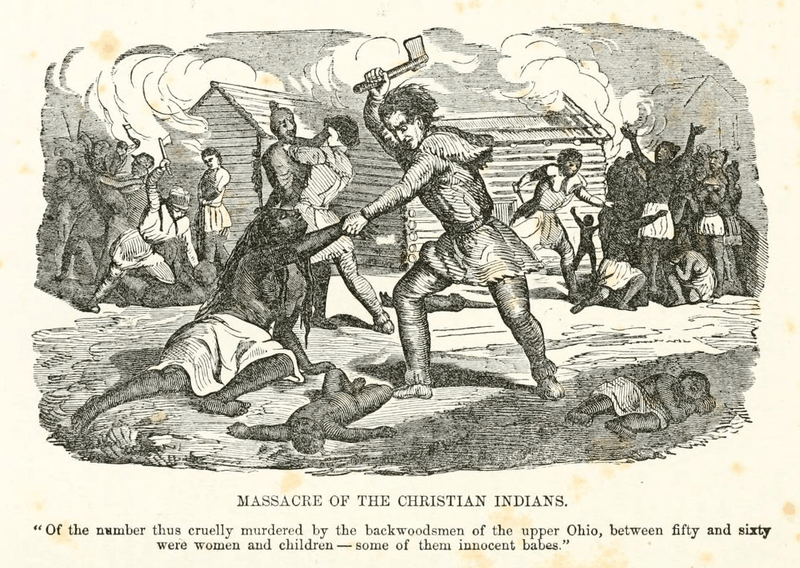
Many Native Americans were killed under the excuse that they were dangerous, but in reality it was because they were different, and the European settlers were afraid of a culture they didn’t understand, so they tried to get rid of them. One example of Native Americans being killed in the name of “safety” is the Gnadenhutten Massacre in 1782 where a Pennsylvania militia killed 96 Delaware Indians. These indigenous people had been converted to Christianity, but the militia still blamed their tribe for attacks on white settlements and proceeded to send them two by two into an ambush where they bludgeoned the whole tribe to death (Fixico). Another example is the Battle of Tippecanoe in 1811. The Shawnee war leader Tecumseh was away trying to improve relations with the Choctaw tribe so that they could band together for protection. The Indiana Territorial Governor William Henry Harrison was afraid of the two tribes banding together and took the opportunity to attack and burn Prophetstown, the Indian capital on the Tippecanoe River (Fixico). Again, an entire town was purposefully slaughtered in the name of “safety.” Finally, another example is The Creek War (1813-1814). An inter-tribal conflict among different Creek Indian factions ended up involving American, British and Spanish settlers. When one American fort was defeated by the Creeks, General Andrew Jackson retaliated by using the Tennessee militia, around 2,500 men, to slaughter 186 Creeks, including women and children, at Tallushatchee (Fixico). Afterwards, Davy Crockett said, “We shot them like dogs!” (Fixico). These are just several examples of “civilized” Eurpoeans using the claim of “fear” to justify wiping out entire tribes including women and children.
Besides wanting to remove the Native Americans because it deemed them “dangerous,” the U.S. Government also wanted to take their land. Despite already taking most of their land in forced treaties, the U.S. government was not satisfied and broke its own treaties, stealing back the remaining land from the various tribes, and passing the Indian Removal Bill of 1830 (Fixico). President Andrew Jackson justified stealing the land by telling Congress, “They have neither the intelligence, the industry, the moral habits, nor the desire of improvement which are essential to any favorable change in their condition. Established in the midst of another and a superior race…they must necessarily yield to the force of circumstances and ere [before] long disappear” (Fixico). This shows that the President, the head of the US government, did not value the culture or lives of the Native Americans, and did not have any problem stealing from them or killing them. He could have made sure they were removed humanely, from the stolen land, but instead he had the army move them west of the Mississippi like cattle, without any supplies, like they were not even human. Thousands died along the way of what became known as the “Trail of Tears” (Fixico). The government did not care about those it barely considered human. It had the land it wanted, and it did not worry about the tragedy of the lost lives and the lost history left behind.
Mass murder was only one method governments used to steal indigenous land and purposefully exterminate the indigenous culture in the United States. “Kill the Indian, save the Man” was the motto of a headmaster of the Carlisle Indian School in Pennsylvania (Paki). He was not talking about murdering a person, but a culture. These new “Indian boarding schools” would forcibly take indigenous minors from various tribes across the nation and enrolling them in local religious boarding schools so they could “eliminate all that was indigenous” and “civilize” them (Irujo). Until now, according to a preacher named Reverend Whitmer who was testifying before Congress, the U.S. government was wasting too much money using warfare to solve its “Indian problem.” He told Congress, “It costs the Government $11,000,000 to kill an Indian. The Church can save him for $1,000!” (Irujo). The boarding school system was implemented, and it was very successful in stripping these children of their culture. According to descendents of these children, “many Native American and Alaska Native children were forcibly separated from their families and taught to forgo their native tongues for English. Many of these children experienced abuse, sexual assault, and punishment at the hands of the residential staff and were converted to various Christian religions. Hundreds of Indigenous children were killed at these schools, and those that survived were never the same” (Paki). In Nevada alone, “more than 30,000 students from more than 200 Native American nations studied at the Stewart Indian Boarding School in Carson City” (Irujo). This theft of cultural identity from the future leaders of the tribes was clearly planned genocide.
According to the person who actually came up with the word, “genocide,” Rapheal Lemkin, genocide is “a coordinated plan of different actions aiming at the destruction of essential foundations of the life of national groups, with the aim of annihilating the groups themselves… The objectives of such a plan would be disintegration of the political and social institutions, of culture, language, national feelings, religion, and the economic existence of national groups, and the destruction of the personal security, liberty, health, dignity, and even the lives of the individuals belonging to such groups” (Irujo). This definition shows that purposefully eliminating the culture of a people is just as much genocide as eliminating the people themselves.
The U.S. government was not the only one who committed genocide against the Native Americans. The State of California was also complicit in the extermination of indigenous peoples and their culture. In that state, the population dropped from 150,000 to 30,0000 between 1846 and 1870 (Madley). While some of these deaths were due to diseases, and others the indirect result of dislocation and starvation caused by the government, most were a direct result of genocide, sanctioned and facilitated by California officials (Madley). One of California’s first orders after becoming a state was to ban all Indigenous people from voting, followed by not allowing them to be on juries, or be lawyers, or give evidence against white people (Madley). This meant that Native Americans were completely at the mercy of anyone who wanted to harm them, and they were also basically treated as slaves by whomever they worked for. Besides giving anyone who wanted to kill the Native Americans an easy way to get away with it, the California government also “called out or authorized no fewer than 24 state militia expeditions between 1850 and 1861, which killed at least 1,340 California Indians. State legislators also passed three bills in the 1850s that raised up to $1.51 million to fund these operations” (Madley). These actions were clearly a purposeful attack on the indigenous people in California to remove them from the population, caused by the government of California, and allowed by the government of the United States of America.
It is clear that great crimes were committed against the Native Americans, but now the question is what could be done to repair a little bit of the damage. First, it is important for all Americans to learn the true extent of what happened to the Native Americans. “87% of schools in this country don’t teach about Native Americans past 1900 and they’re certainly not teaching about the boarding schools” (Paki). People need to understand what happened so that it does not happen again, and so they can understand what was lost in order to understand what kind of reparations should be made. According to descendents of boarding school children, “We are one of the most misunderstood populations in this country. We’ve always been defined by nonnatives in white-written history books” (Paki).
Second, the government should help fund the preservation of what is left of the cultural heritage of the various tribes, the artifacts, the lands, and the stories of the people. There are many groups now trying to learn more about what happened, and preserve what is left, especially the stories that come directly from those affected.
Third, the government should assist the current generation of Native Americans in regaining their heritage and in healing from the generational trauma that was passed down from their ancestors who survived the abuse at the boarding schools.
Some might claim that the United States had the right to take whatever land it could by “survival of the fittest” rules, and that if it was not them, then another technologically advanced society, like Britain, Spain, or later Germany might have conquered them and taken the land. They might say it is good that the United States has the entire continent, because it has needed that security to become the powerful nation it is today. How long would a more primitive civilization have lasted, anyway, they might wonder, among countries with superior technology during the industrial revolution?
The Native Americans would not have stayed as technologically primitive as they were. Their culture would not have died off, it would have just evolved like European culture has over the years. They would not have lost their language and their traditions. Their culture would have influenced Europeans’, and Europeans’ theirs, and both would have benefited. Also, the blending of the cultures and the forming of strong treaties that were NOT broken would have formed alliances that kept other countries from taking them over, and we would still be the powerful nation we are today. Besides that, even if taking land for security reasons is valid, how it is done matters! Murdering and abusing people, violating basic human rights, is never acceptable in a “civilized” society. There was no valid reason to justify the inhumane treatment of the Native Americans by the U.S. federal or state governments.
In conclusion, the government of the United States of America committed genocide against many Native American tribes, severely affecting their future generations, and it should pay reparations to those tribes. Entire towns and tribes were purposefully slaughtered, including noncombatants, women, and children. Tribal lands were stolen, valid U.S. treaties broken, and their inhabitants forced to walk hundreds of miles without supplies or shelter, causing thousands to perish along the way. Indigenous children were forcibly removed from their families to be raised in boarding schools and stripped of their language, traditions, and cultural identity. Many died from abuse at the hands of their custodians, and those that survived passed their trauma down to their descendants. The Native American tribes made treaties in good faith with the U.S. government and were betrayed, their tribes decimated, their cultures all but erased. This genocide is a national disgrace and a permanent stain on the honor of this country. The U.S. government must be held accountable for its actions and must make reparations in order to restore some of this country’s valuable history and culture that is in danger of being lost forever.
Works Cited
Fixico, Donald L. “When Native Americans Were Slaughtered in the Name of ‘Civilization.’” This Day on August 29, 1911: A Survivor of American Indian Genocide Walks Out of the California Wilderness, history.com, 2 March 2018, https://www.history.com/news/native-americans-genocide-united-states. Accessed 8 May 2024.
Irujo, Xabier. “Genocide, kill the Indian and save the man.” University of Nevada, Reno, Nevada Today, 8 October 2021, https://www.unr.edu/nevada-today/news/2021/genocide-kill-indian-save-man. Accessed 8 May 2024.
Madley, Benjamin. “It’s time to acknowledge the genocide of California’s Indians.” CALIFORNIA STATE UNIVERSITY LONG BEACH American Indian Studies, CALIFORNIA STATE UNIVERSITY LONG BEACH American Indian Studies, https://cla.csulb.edu/departments/americanindianstudies/benjamin-madely-an-american-genocide-the-california-indian-catastrophe-1846-1873/.
Paki, Maka Montu. “Crimes of Native American Boarding Schools Embarks on a Quest for Truth and Healing.” Vanity Fair, Vanity Fair, 10 May 2023, https://www.vanityfair.com/style/2023/05/american-genocide-the-crimes-of-native-american-boarding-schools-truth-and-healing. Accessed 8 May 2024.Stone, Jason. “Historian Examines Native American Genocide, its Legacy, and Survivors | Around the O.” Historian Examines Native American Genocide, its Legacy, and Survivors, University of Oregon, 20 January 2021, https://around.uoregon.edu/content/historian-examines-native-american-genocide-its-legacy-and-survivors. Accessed 8 May 2024.
 The Raider Press