
By Kaelyn DiMartino ’25
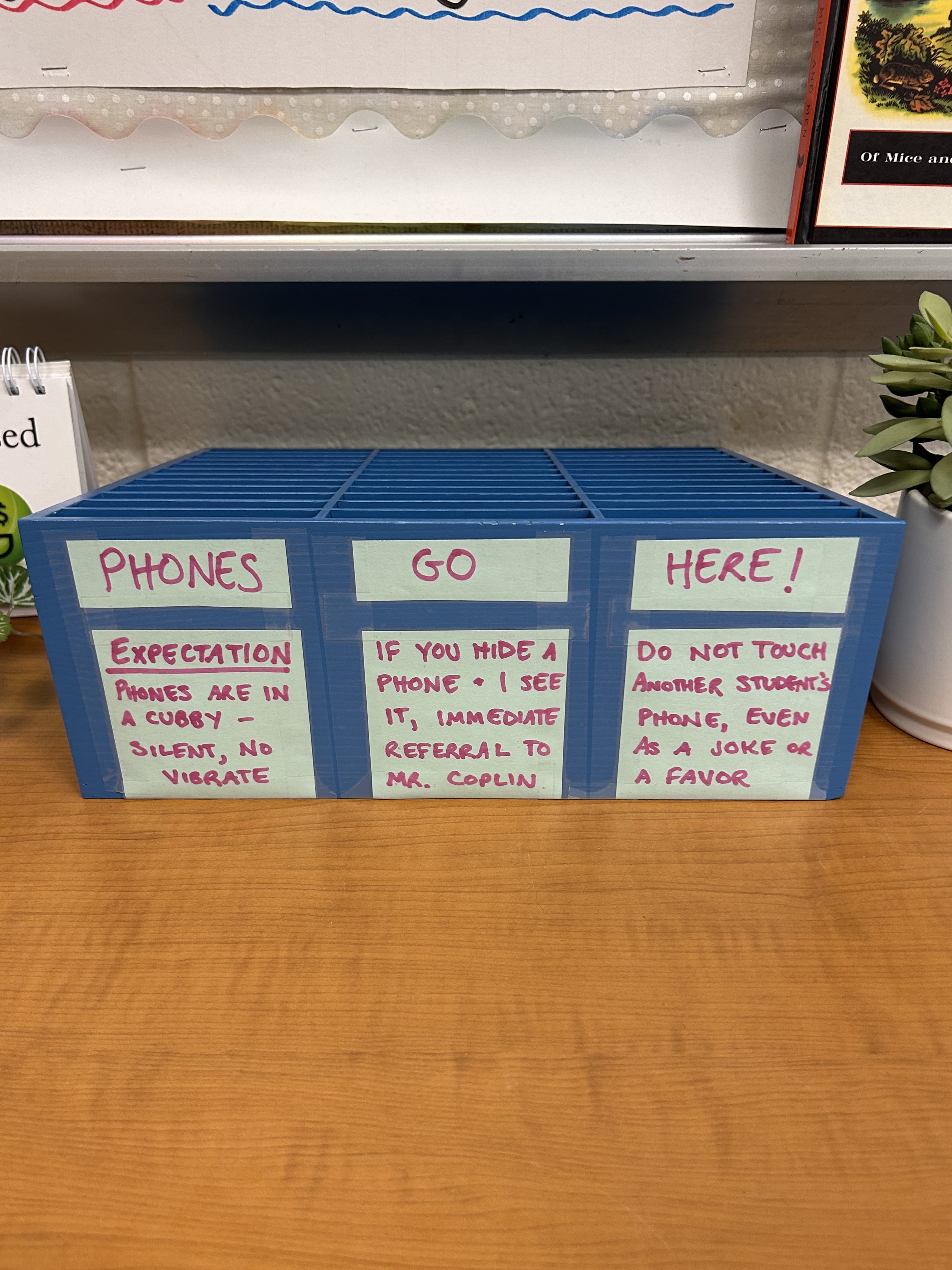
Towards the end of Oct., which was about a month ago, blue phone stations were distributed to five classrooms at Derby High School. Each day students go into class and are required to put their phones in a slot in the phone station. These five teachers are Matthew Nicolari, Jessica Yanes, Sara Sicona, Spenser Butterworth, and Brendan Serra. They volunteered to put these stations in their classrooms to test out the method. This method is being used to make sure students are staying on task and that they do not have any distractions. Phones tend to be very distracting for all students throughout the school, which is why this method is being implemented and tested.
Here is a questionnaire that I gave to these five teachers:
Kaelyn DiMartino: Do you feel students are better with or without their phones?
Mathew Niccolari: I feel like they are better focused without phones during instruction. I think that during instruction, when I am up in front of the class explaining what we are doing or lecturing, there are many more on task. Sometimes when they are working independently I think it is just the same as if they have their phones because for the most part students focus when they have their phones independently. It is more just during instruction when this helps.
Jessica Yanes: Definitely, without phones, students are better focused. A couple of years ago right after the pandemic when students were coming back from hybrid learning or remote learning the phones were a constant distraction. Students were glued to their phones, and it has gotten a little bit better since we have some distance from the pandemic, but I still think it is a huge problem. Very distracting for a lot of kids.
Sara Sicona: Definitely without, absolutely without.
Spenser Butterworth: I would say within these first few weeks of having the phone stations, there’s definitely been an improvement in student engagement and probably attention span without the constant distraction of their cell phones, so I would say I agree with students not having them during the class period.
Brendan Serra: Without. On a day-to-day basis for activities, I see a difference for the students who have the tendency to be on their phones. When students are off their phones, they are less likely to ask me to repeat things and they are more likely to focus on the work we are doing.
KD: How has this change impacted the classroom?
MN: Way more students are on task especially during initial instruction or during lectures. Less time is taken away from me having to redirect a student to put their phone away. All of that has been instead switched into time where I can help people and make sure they understand what we are doing.
JY: It has made things a lot nicer for me because I don’t have to constantly be saying, “Put your phone away” I can actually focus on giving instructions and helping students with what they need rather than wasting time trying to get them to do what they are supposed to do.
SS: The students seem way more productive without the distraction of the phone. They seem to work bell-to-bell and I do not have to repeat objectives and remind them to make eye contact with me while I lecture.
SB: I think students are asking more questions and are communicating with each other within the classroom instead of being on their phone. It has led to easier discussions and assignment completion.
BS: Far less students being distracted, far less students asking to repeat something while I am teaching like “Can you explain that” or “Can you go back.” Maybe once or twice a day I get that, but students are far more paying attention to the small details.
KD: Do you use phone stations in all your class periods?
MN: To stay consistent I think it is only fair to use it in every classroom, so I do.
JY: Yes, except advisory.
SS: Yes, I do.
SB: Yes, the students check the daily agenda and put their phones in the station as do I.
BS: I use them in almost all of my class periods. I do not use them in physics primarily because we often use them as tools for our labs and assignments.
KD: Have you seen anyone use a fake phone or try to get around using the phone station?
MN: I have not noticed this yet, but I set the expectation that the phones need to be in the station and if you think that you are tricking me by keeping it and you take it out at all, you’re going to get in the most of your punishment possible just to set an example.
JY: I caught my first decoy phone last week. A student put a phone in the phone station and left it there the whole day and didn’t come back to get it, and they did the same thing the following day which told me this was a phone they did not care about. I asked them about it and they basically admitted that it was their decoy phone and since then it has not been an issue.
SS: It is almost a reflex for them to instinctively pull their phone out. I have never seen fake phones, but I have seen that they can’t control their motor skills.
SB: I personally have not seen any incidents like that, but I’m sure it has occurred in different areas of the school.
BS: I have not seen the fake phones nor do I necessarily inspect every phone that goes in there. I understand that some students are probably putting phones in their pockets though. I see students using their apple watches as well.
KD: Do you think all grade levels should have phone stations?
MN: I think that all grade levels should use them because otherwise it creates an unfairness between the classes. Uniformity I think is better.
JY: I think all grade levels should use the phone stations.
SS: We should start at freshmen, but yes every single student needs to.
SB: I think to be fair and equitable we would have to do it across the entire school.
BS: Usually it is most effective if it is done across the whole school. Do I think seniors absolutely need it? I think they could do better with trying to learn how to cope with their work and also have their phone out, because in college they will have their phones with them.
KD: Should the school keep these phone stations?
MN:Yes.
JY: Yes.
SS: Yes.
SB: Yes.
BS: Yes.
KD: Are the phone stations helping students?
MN:Yes.
JY: Yes.
SS: Yes.
SB: Yes.
BS: Yes.
 The Raider Press