
By Vincent Trinh ’25
Summary:
“Fight Club” is the 1999 film adaptation of the novel of the same name by Chuck Palahniuk. The film follows an unnamed protagonist with insomnia who works a dull office job. That is, until, he meets Tyler Durden. Tyler is a hypermasculine devil-may-care soap salesman who radically criticizes the consumerist culture of modern capitalist society. The two create a club where men beat each other black and blue in one-on-one fights called “Fight Club.” It serves as a way for men to reclaim their masculinity after their symbolic emasculation, and take out their primitive anger. Tyler then takes it a step further and creates Project Mayhem. This is a domestic terrorist organization with the end goal of destabilizing and destroying capitalist modern-day society. The film resonated with millions of American men and saw unprecedented popularity. Tyler’s “fight the system” attitude, along with Palahniuk’s criticism of consumerist culture, were the perfect recipe for American men to fall in love with it. “Fight Club ’s” themes and messages are still relevant today, with a growing fan base. Depending on who you ask, the film adaptation is almost an exact replica of the novel’s overall plot. However, for those who read the book, glaring details can potentially change how we perceive Palahniuk’s characters…
1. Project Mayhem
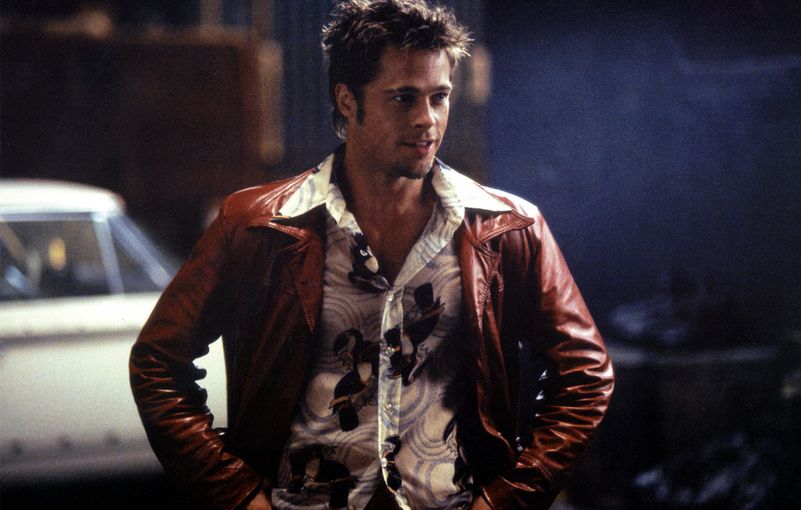
In the film, Tyler frames Project Mayhem as a solution to the dehumanizing consumerism of modern society. It’s used as a statement. His team of brainwashed men he calls Space Monkeys are sent out to cause controlled chaos and havoc. While Tyler wishes to destroy modern society, he refrains from harming people directly. Film Tyler tells the Space Monkeys to destroy corporate modern art and destroy credit card buildings. Tyler, in his messianic delusion, believes that keeping people from dying shows that he is justified in his beliefs. However, the book version of Project Mayhem is anything but. Book Tyler doesn’t need to rely on contradictory Hollywood-baked political statements (Tyler Durden is played by Brad Pitt, a famous Hollywood actor with lots of money, who tells us we shouldn’t give into consumerism). No, book Tyler is an anarchical maniac. His acts are not justified nor beneficial to anyone but himself. The Project Mayhem in the book doesn’t stop at modern art and credit card buildings. The book has Space Monkeys committing mass-scale arson, crashing expensive cars, and inducing hatred into the minds of the neglected and unaccounted for. Tyler leads this army to create true anarchy. Palahniuk writes, “‘Don’t get any bullets,’ Tyler told the Assault Committee. ‘And just so you don’t worry about it, yes, you’re going to have to kill someone’” (Palahniuk 125). Book Tyler doesn’t reduce his acts of terrorism to mere anti-consumerism. He is the cold merciless vessel of an outraged working class of men.
2. The Raymond Parable

There is a moment in the film where Tyler and the unnamed narrator stroll by a small corner store. A man exits the corner store and Tyler grabs him at gunpoint. The narrator is appalled and tries to convince Tyler to stop. Tyler doesn’t stop and pulls the trigger, but the gun is not loaded. Tyler lets the poor man go and says, “Raymond K.K. Hessel, your dinner is going to taste better than any meal you’ve ever eaten, and tomorrow will be the most beautiful day of your entire life.” This moment almost marks the beginning of Tyler’s descent into radicalism and away from petty pranks like urinating in food as a waiter. Even if the gun wasn’t loaded, Tyler just assaulted and threatened this man who believed that he would die. This veers Tyler into more of a psychopathic character type. However, the book shows the different sides of the troubled men in the fight club. The book makes it so that the narrator is the one performing this terrorizing stunt. This changes how we view the narrator as a character drastically. We go from seeing him as a witness (biblical reference intentional) to a devout follower. The narrator states, “This is what Tyler wants me to do. These are Tyler’s words coming out of my mouth. I am Tyler’s mouth. I am Tyler’s hands. Everybody in Project Mayhem is part of Tyler Durden, and vice versa.”
3. Marla

Marla is the narrator’s love interest and partner, other than Tyler, to accompany him on this bizarre journey. She serves to reflect how the narrator’s approach to nihilism is somehow worse than the disturbing things that Marla has done to cope. While Marla attempts suicide and leads a heavily hedonistic lifestyle, she does not kill people. Marla is a complex character, but the film almost misinterprets her complexity for comedic relief. The director does not take Marla’s character seriously as Palahniuk had made her in the book. Film Marla explains that she goes to various support groups because “It’s cheaper than a movie and there’s free coffee.” This almost discards Marla’s character as a carefree soul, which is nothing like book-Marla. In the book, Marla has breast cancer. She has known ever since she found a lump on her body prior to the events of the story and copes with her depression. Marla with a breast lump changes her entire character. It gives a very real and relatable reason for her depressive and nihilistic behavior. It even provides a genuinely heart-wrenching explanation for her time at the support groups. Marla is dying, and she only feels alive when she goes there. Her reasoning for that is that the support groups are the only thing that makes her feel alive. She is a sad existence and looks to the support groups (like the narrator’s attempts at escapism through consumerism) for feeling alive.
4. Where Is My Mind?

The narrator that we follow throughout the film is played by Edward Norton. Norton’s performance of the narrator evokes modern nihilism and insomniac behavior. His eyes are drooped and the semblance of a smile is only saved for the most cathartic moments. His nihilism pushes him to follow Tyler Durden. As a disciple, the film narrator does what he is told up until the aforementioned “Raymond Parable.” It is from then on that he begins to question the moral and philosophical implications that Tyler’s doctrine poses against normality. However, not once in the film does the narrator express this skepticism or doubt. He simply chooses not to be involved with Tyler’s radical plans. In the book, the Narrator exhibits this in one subtle yet sophisticated detail. He states, “Under and behind and inside everything I took for granted, something horrible has been growing. Everything has fallen apart” (Palahniuk 202). He says that he took his nihilistic normality for granted and that he is losing it all before his very eyes, as if it’s too late to save something he never saw as significant to him as now. But it’s too late, way too late, for that now. Without this quote, the movie narrator leaves much more to interpretation when it comes to the implications of “Fight Club” as a whole. Without this subtle and small detail, the narrator as a character is completely warped.
5. Am I in Heaven?

The film ends iconically as the narrator watches credit card buildings explosively collapse all around him from the window view of an abandoned building. The scene is fittingly accompanied by the song “Where Is My Mind” by the Pixies. While the film ends in this climactic moment, the book doesn’t. The book continues after the explosion and sees the narrator hospitalized. He says that he has “met god” and went to Heaven. This humorous remark is unclear as it is only implied not confirmed that he didn’t go to heaven and was only hospitalized. The narrator is visited by men who bring him trays of food and drink every day. One of them says, “We look forward to getting you back.” This implies that Tyler’s Space Monkeys are awaiting his eventual return. This sets up the framework for the sequel to “Fight Club,” “Fight Club Two.”
David Fincher’s Fight Club made me fall in love with Palahniuk’s gothic and grotesque characters. However, after reading the book, I learned to love them even more. Fincher’s adaptation, in its own right, innovated and added to Palahniuk’s complex tone and themes. There is truly nothing like Fincher’s grungy 2000s off-the-wall style in film. Having abandoned, dirty, and downright disgusting places for the film to be set added personality to the world of “Fight Club.” Modern-century graffiti and obnoxious music made for an “in your face” cinematic experience that ceases to blow me away. My heart belongs to Fincher’s “Fight Club,” but the reader in me screams for Palahniuk’s classic novel. Ignoring all of the differences between the two, Palahniuk’s novel was lightning in a bottle. He wrote his characters with rich detail and placed them into nothing short of surreal circumstances. There is something so raw about how Palahniuk’s caricature seemed to speak to the modern-day nihilism that most people have, but take it to an extreme level. I will always have a personal connection to Palahniuk’s characters because I am an easily impressionable teenager. Palahniuk’s “Fight Club” gave us a wake-up call, but not the one most think of. To me, Palahniuk’s “Fight Club” (without the Hollywood fluff) taught a generation of young men to be careful who we listen to and what we say. I would take the book over the movie any day.
 The Raider Press