
By Alexandra Karaleva ’27
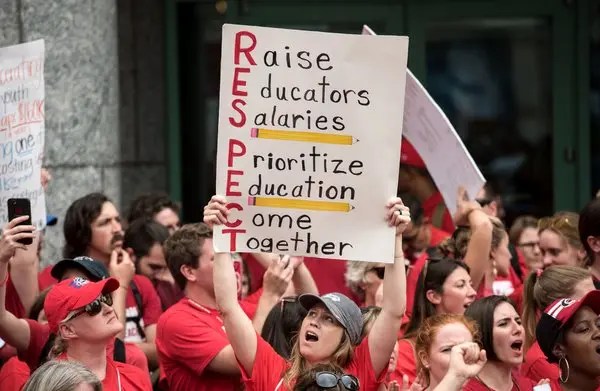
Teachers in the U.S. are constantly being underestimated and belittled. Even their pay can be viewed as disrespectful to the educational foundation they provide, as “teachers make all other professions possible” (Aolain). Teachers deserve to be paid more because of their hard work educating students and setting them up for a successful future. A career that sets the foundation for all other jobs shouldn’t cause many of its workers to get second jobs to make a livable salary. Although the pay increases as an educator becomes more experienced, it shouldn’t take many years for it to rise to a somewhat acceptable paycheck. An article written in 2022 states, “Teachers are bringing home on average $2,179 less per year than they did a decade ago, when adjusted for inflation” (Walker). If the cost of living is overpowering the salary raise, then what is the point of calling it a “raise?”
A teacher’s salary depends on the location and district they work for. “Places where teachers are not paid very well are often also places where schools have relatively little funding to begin with, which can impact students’ education as much as it can impact teachers’ livelihoods” (“Teacher Salary by State”). It’s not reasonable for a profession to have a $60,000 wage gap between the highest and lowest state averages. However, it is reasonable for different teachers of different school levels to have some variation. For example, a preschool teacher and a high school teacher having different salaries is understandable, but it can be argued that each deals with difficulties, and they shouldn’t be compared in that way to decide what money they make. Special education teachers also have differences from normal teachers. The average wage gap between high school special education teachers and every grade level below is $3,000; that’s not a lot. All of these issues with being underpaid are why we have lost so many educators. “McKinsey research shows that 42% of educators have left because of poor compensation, while 48% of educators are planning to leave” (Peck). Imagine what a catastrophe that would be for the education system. It’s unfortunate that approximately one-fifth of all teachers acquire second jobs to make enough money to support themselves and/or their families.
America’s crazy school shootings are a huge factor in why there’s a lack of teachers. How can there be such a known huge risk and such a small pay? Teachers deal with many students every day, and in a utopian world, each student would have equal education opportunities, but that is simply not the case. Some districts and locations don’t have access or options to get amazing educators. “Performance pay plans also help districts recruit high-quality teachers. Research shows that, on average, school districts that adopted pay-for-performance hired new teachers who had graduated from colleges and universities with average SAT scores that were about 30 points higher than new teachers hired by districts that didn’t adopt performance pay” (Armstrong).
Unfortunately, because states have the reserved right to decide teacher compensation, there’s bound to be a wide variety, even if deemed inequitable. The future of the U.S. is in all educators’ hands because they are the ones setting future generations up for success. Public opinion seems to not have a huge impact on what is being done to fix this issue. “The public thinks teachers deserve a raise. Last year, 72 percent of respondents to the annual Education Next survey said that teacher salaries should be higher, and just 4 percent said they should be lower. (Among Republicans, the split was 56 percent to 7 percent)” (Hess). If a vast majority constantly raises concerns about an issue, then why isn’t it taken seriously? There has to be a breaking point for this because it’s becoming embarrassing and out of control. “Teacher pay has suffered a sharp decline compared with the pay of other college-educated workers. On average, teachers made 26.4% less than other similarly educated professionals in 2022—the lowest level since 1960” (Allegretto). We should be progressing as a society and being more appreciative of those who have led us to success, not doing the opposite.
Some may argue that an increase in teacher pay won’t stop teachers from quitting or state testing levels from plummeting. “If our hope is that improving teacher pay will improve student outcomes, then we will likely be disappointed. Higher pay does not make a hard job easier to perform. It lifts no burden off a teacher’s shoulders, nor does it add hours to a teacher’s day” (Pondiscio). I’d like to mention when the author says, “Higher pay does not make a hard job easier to perform,” because that sounds ridiculous, and it seems like the author doesn’t understand what the point being brought across is. The text is also wrong when saying, “It lifts no burden off a teacher’s shoulders” because getting paid more does lift a burden; it’s a reward for the hard work. It makes no sense to downplay the hard work of teachers. “Time spent creating lessons from scratch or searching for materials on the Internet is time not spent analyzing student work, giving students feedback, building subject matter expertise, cultivating strong relationships with students and their parents—all of which are higher-yielding uses of teachers’ time and energy. Worse, studies have consistently demonstrated “”the teacher-created lessons tend to be below standard and lacking in rigor— another drag on student outcomes” (Pondiscio). Social media and the internet are simply a huge part of this generation’s lifestyle. A teacher shouldn’t be downplayed for using the resources given to them. Students using technology when not permitted to is what should be the main focus. The double standard from student to teacher is truly ironic and humorous, but to a teacher, very aggravating.
Overall, teachers deserve, and have always deserved, to have a job with very high pay. What they do for us is constantly undermined, and eventually everyone will realize that, but they shouldn’t be treated like this anyway, now or later. “It’s a win to get more students in the classrooms of our strongest teachers, so long as those teachers don’t feel put upon” (Hess). A balance between teachers, students, and salaries is something that should be worked on because this issue could be worked on and at least improved in some ways. It’s sad that so many teenagers don’t go to college to become teachers because of the pay. Imagine how many smart, kind, and impactful educators could be out helping kids every day if only they were paid fairly.
Works Cited
Allegretto, Sylvia. “Teacher pay penalty still looms large.” Economic Policy Institute, 29 September 2023, https://www.epi.org/publication/teacher-pay-in-2022/. Accessed 6 May 2025.
Aolain, Catriona N. “‘Teachers Make All Other Professions Possible’: This Educator Shares Her Why.” EducationWeek, 10 April 2024, https://www.edweek.org/teaching-learning/teachers-make-all-other-professions-possible-this-educator-shares-her-why/2024/04. Accessed 4 May 2025.
Armstrong, Patricia S. “Teacher Compensation Strategies.” National Counsel on Teacher Quality, September 2022, https://www.nctq.org/research-insights/state-of-the-states-2022-teacher-compensation-strategies/#:~:text=Salaries%20are%20one%20of%20the,%2C%20effective%2C%20and%20diverse%20teachers. Accessed 1 May 2025.
Hess, Frederick M. “Pay Teachers, Not Administrators.” EBSCO, 12 June 2023, https://research.ebsco.com/c/55jvny/viewer/pdf/a5r4fh7i6j?auth-callid=4d8690ad-5a65-490c-a148-bba9589af276. Accessed 1 May 2025.
Peck, Devlin. “Why Teachers Quit + What You Can Do Instead.” Devlin Peck, 9 December 2024, https://www.devlinpeck.com/content/why-teachers-quit#:~:text=Low%20salaries&text=In%20fact%2C%20McKinsey%20research%20shows,educators%20are%20planning%20to%20leave. Accessed 16 May 2025.
Pondiscio, Robert. “Higher Pay Won’t Solve Teachers’ Problems.” American Enterprise Institute, 20 June 2024, https://www.help.senate.gov/imo/media/doc/b1f1b1f0-ff3d-4046-fa07-587b0725525a/Pondiscio%20-%20Senate%20Testimony%2006-20-20241.pdf. Accessed 6 May 2025.
“Teacher Salary by State.” Study.com, https://study.com/academy/popular/teacher-salary-by-state.html. Accessed 1 May 2025.
Walker, Tim. “Average Teacher Salary Lower Today Than Ten Years Ago, NEA Report Finds.” neaToday, 26 April 2022, https://www.nea.org/nea-today/all-news-articles/average-teacher-salary-lower-today-ten-years-ago-nea-report-finds. Accessed 15 May 2025.
 The Raider Press