
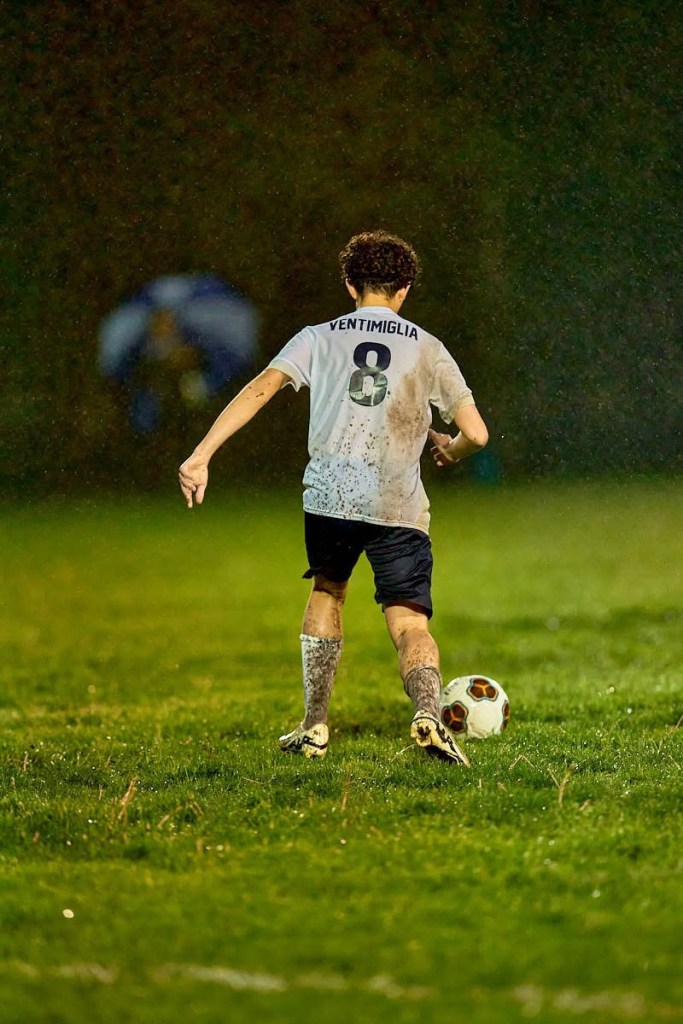
By Luca Ventimiglia ’27
In the U.S. today, many children who play club soccer are prevented from playing by the pay-to-play system (Fierce United). For instance, a reporter from The Guardian says, “You don’t want to have a situation where a good player can’t go on to play at a higher level because they can’t afford the fees” (Baldi). Access to youth soccer should be free or more affordable in the U.S. This can ensure equal opportunities for all soccer players. The pay-to-play system causes barriers that prevent players from advancing their skills and playing competitively.
The cost of club soccer programs are absolutely crazy. The costs should be free or more affordable. The U.S. is known for not being good at soccer because there are so many kids that do not get to play competitively as many families have financial issues (Ruiz). Gio Ruiz says, “This high-cost barrier ultimately leads to the reduction in the number of talented soccer players and reduces the competitiveness of American soccer. U.S. soccer fans saw the consequences of this barrier when the U.S. men’s national team failed to qualify for the 2018 World Cup and their disappointing performance in the 2022 World Cup by crashing out in the Round of 16 against the Netherlands. These disappointing results need to be addressed and one way to start is by changing the youth system and getting rid of the pay-to-play model in the American Soccer system” (Ruiz).
Some of the most famous soccer players grew up impoverished, and the U.S. soccer system prevents impoverished players from showing off their skills or enhancing them. Believe it or not, parents of the players sometimes have to work two jobs just to cover the costs of club soccer (Ruiz). In other countries, mainly in Europe, the club costs are very cheap compared to the U.S., leading the other national teams to future success (Ruiz). Ruiz says, “In Europe, some academies like Paris Saint Germain charge $200 a year for children to play. On the other hand, in America expenses to join an academy range from $2,800 to $3,500 a year, which is an absurd amount of money to pay so your kid can develop their soccer skills. The French National Soccer team has a way better team than the U.S. National Soccer team and that is because they have more affordable soccer programs compared to the unaffordable programs in the United States” (Ruiz). Yes, the PSG academy isn’t free, but it is way cheaper than clubs/academies in the U.S. Also, in France, their target goal is to build prospects for their national team, not to gain loads of money.
Equal opportunity for all players is a crucial element in terms of club soccer finances. With equal opportunities for all players, it gives a chance for the non-financially fortunate players to experience a club team and to play competitively (Blair). Elizabeth Blair explains, “Another problem with pay-to-play: inequities on school teams. Kids who can’t afford club soccer could play on their high school teams where it’s generally free. But in tryouts, they often have to compete against more experienced kids who come from families that can pay for clubs” (Blair). Since not all players get the opportunity to advance and develop their soccer skills on a club team, these players mostly have to rely on high school soccer to play, although the majority of high school soccer players play on a club team which gives them an advantage over the other players that don’t when it comes to tryouts. This can lead to the non-club players not being able to play soccer for their high school team even though it is free (Blair).
The pay-to-play system causes many barriers when it comes to players attempting to join a club. Here in the U.S., the goal to develop players’ skills requires a lot of funding, hence the hefty prices of club soccer. In other countries, they reach the development of players’ skills through “centers of excellence” (Morgan and Whitehead). If we take a look at France’s Kylian Mbappe, star of the France National Team, he was trained through France’s center of excellence for youth soccer players, Clairefontaine. Clairefontaine is a place where players can showcase their skills to some of the best coaches in France and also learn new tactics, techniques, and skills along the way. Also, it is an experience where you can stay for about a week at a time, still get educated by teachers, and have a good time if selected. If the player develops into one of the best prospects at Clairefontaine, they get selected for the national team (Lawrence). Amy Lawrence states, “The other key principle is there are boys who will succeed in football, and there are boys who will succeed elsewhere and that’s why we are also giving them an educational background, making a real investment in them. We can say to the boys here, ‘Either you become a footballer, or you have the backup, because you continued your studies, to be able to do something else’. The French system and the training course is designed to leave nobody behind” (Lawrence). Clairefontaine not only makes players better, but also prepares them for their future lives if they end up not playing soccer professionally.
Some people argue that spending a lot of money for their kids to enhance their skills is good because the more they spend, the better training they will receive (Blair). However, this is not the case. Surprisingly, the coaches throughout U.S. soccer clubs are not the greatest (Blair). You would think that people would be getting their bang for their buck because of the ridiculous fees, but that’s not how the pay-to-play system works. Zooming in on this quote, Elizabeth Blair claims, “Paying to play doesn’t guarantee a child will receive the best coaching, either. People think that the more I put into my child’s experience financially, the more successful they’re going to be and the more they’re going to get out of it. And we do not find that to be the case.”
I chose to write about this topic because these crazy prices of club soccer have prevented me from playing competitively. After completing the tryouts for club soccer, you have the chance that the club accepted you or didn’t accept you. You would think that’s it right, but no. If you get accepted into the club, you then have to pay this crazy fee to get in even though you passed tryouts. All in all, access to youth soccer should definitely be free or more affordable in the U.S. so that we can ensure equal opportunities for all soccer players, and to get rid of the barriers the pay-to-play system provides.
Works Cited
Baldi, Ryan. “You can’t have barriers’: is pay-to-play having a corrosive effect on US soccer?” The Guardian, 23 July 2024. Accessed 6 May 2025.
Blair, Elizabeth. “Club soccer puts the sport out of reach for many kids.” npr, 8 Dec. 2022. Accessed 6 May 2025.
Fierce United. “The Problematic “Pay-to-Play” System in U.S. Youth Soccer.” 20 May 2023. Accessed 29 April 2025.
Lawrence, Amy. “Welcome to Clairefontaine, the French footballing wonderland that helped nurture Kylian Mbappe.” New York Times, 17 September 2024. Accessed 30 April 2025.
Morgan, O. Ashton, and John C. Whitehead. “Willingness To Pay For Soccer Player Development In The United States.” p. 19. Accessed 1 May 2025.
Ruiz, Gio Romero. “Why should soccer opportunities be free to everyone?” 15 Feb. 2023. Accessed 5 May 2025.
 The Raider Press