
By Ariana McNeill ’27
Social Media: apps used by many adults, adolescents, young teens, and children may be affecting us and our daily lives, and we don’t even know it. Social media is used by many people today. It is shown to have positives like communication, expressing yourself, and more. But we soon realize that social media has negatives as well, like depression, anxiety, and other known mental health risks. Our beloved apps like TikTok, Instagram, Snapchat, Facebook, and Twitter, can be affecting us, and all we can do, instead of getting rid of social media all around, is mask or make solutions to all the negatives. This would lead to increasing the positives, which is needed to keep social media going and stay a positive place for people to be on every day.
In all, social media has many positives but mostly negatives for children. Although children can express themselves, social media increases the rates of anxiety and depression because of the amount of cyberbullying and comparison within the apps. To try to reduce these rates, social media can be more protective and not allow the exposure of cyberbullying, and other aspects that may affect a child’s brain development in negative ways, as well as parents becoming more aware of the use of social media regarding their children.
Many people love to show off their creativity on social media as a way to express themselves. There are many videos and photos you see on social media showing how much fun friends are having with each other. Social media is a place where people can show their lives and the fun times; it also keeps memories. For example, “In a survey of U.S. teens ages 13 to 17, 74% said social media makes them feel more connected to their friends, and 63% said online platforms give them a place to show off their creativity” (Upton). Many family members, friends, and associates use social media apps to communicate with family members from far away. It’s a place where young children and adolescents can laugh and relate to, which is why social media is such a big part of many people’s lives today. Furthermore, “Social media can provide benefits for some youth by providing positive community and connection with others who share identities, abilities, and interests” (Office of the Surgeon General).
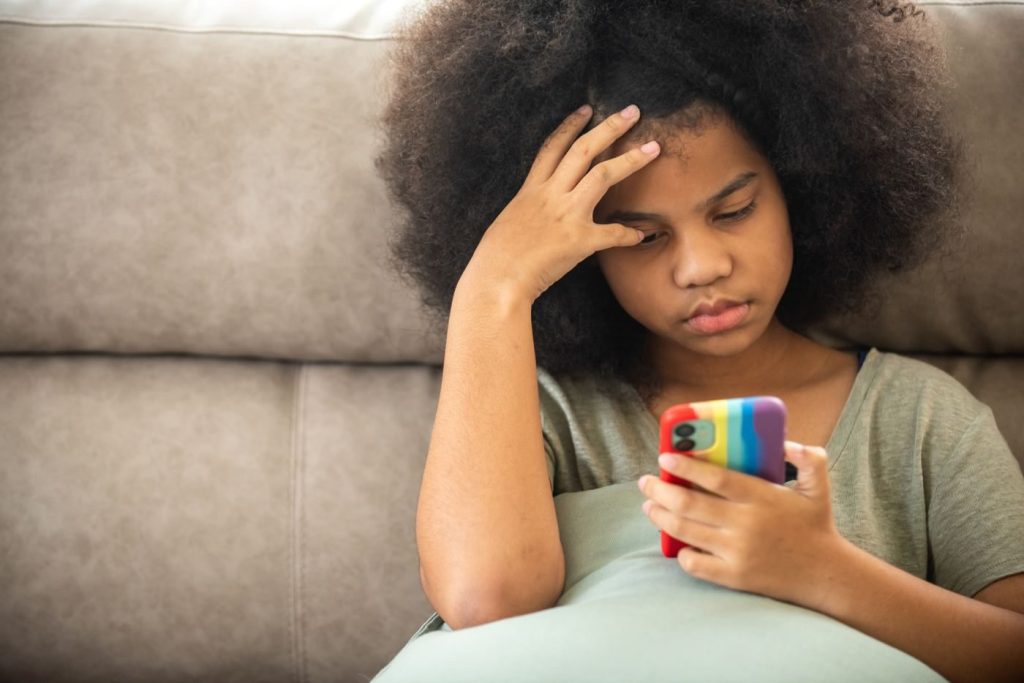
Although we see the positives of social media, there are many negatives that some people like to forget. Cyberbullying is a big negative. One study “emphasised that cyberbullying and harmful content, exacerbating feelings of isolation and vulnerability, are linked to the prolonged use of social media platforms” (Ali). The sense of vulnerability is really bad if it gets to a certain point. Cyberbullying can lead to such a high rate of vulnerability that it increases the rates of depression, anxiety, and maybe even suicidal thoughts. As anxiety and depression rates increase, it makes many children and adolescents distance themselves from family and friends. They have a much different demeanor that parents should look out for if their child is on social media.
There are a lot of comparisons shown on social media, which is a big thing that increases the rates of anxiety and depression among children and adolescents. “On the other hand, [social media] can foster feelings of inadequacy, anxiety, and isolation, especially when a child’s self-worth becomes tied to likes, followers, or virtual approval” (“Impact of Social Media on Children’s Mental Health”). Social media is a big place that many children and adolescents don’t know how to handle, especially if they’re already in a bad mindset.
All the comparisons, anxiety, depression, and cyberbullying can overall lead to negative effects on a child or adolescent’s brain development. The human brain isn’t fully developed until mid to late 20s, meaning the brain is still learning, especially at a younger age. Specifically, “in early adolescence, when identities and sense of self-worth are forming, brain development is especially susceptible to social pressures, peer opinions, and peer comparison” (Office of the Surgeon General). Because the brain is still developing and is vulnerable during the period of adolescence, social media needs to be studied more so we can see how deeply it can affect a child or adolescent’s brain development.
According to some, “Despite these concerns, social media is not inherently harmful. When used intentionally and in moderation, it can serve as a powerful tool for social connection, education, and self-expression” (Callahan). This is true, social media is a great place for education and self-expression, but too much social media may not be. “Children with their own smartphone also spent more days each week hanging out with friends in person and were more likely to say they felt good about themselves” (Cook). However, many children and adolescents learn to be dependent. It can also lead them to exposure to negative things at an early age. There are things on social media that children and adolescents shouldn’t be exposed to at a young age, but are because of social media.
There are many ways for social media to become more of a positive place for children and adolescents, like parents becoming more aware, setting a screen time limit, and modeling responsive behavior. By parents becoming more aware and watching for warning signs, it can save the hassle of children and adolescents’ mental health rates increasing negatively. Specifically, “Setting screen-time limits, encouraging open conversations about online experiences, and modeling responsible behavior are all essential” (“Impact of Social Media on Children’s Mental Health”). As social media grows, we need to as well. Otherwise, social media will grow negatively and positively. If we work harder to pay attention and work on things towards social media for our children, it will save many generations to come.
Although social media has many negatives and positives, I see no reason to diminish social media altogether. We should instead focus on ways to increase mental health among children and adolescents. We all need to become aware of what is going on within social media. But not only does this come down to us, but it comes down to the organizations creating these apps. These apps need to be a safer space and to keep children and adolescents safe, then they need to do what is needed to lower the negative effects, causing a downfall in mental health. If, to reduce the negatives on social media, we need to shorten screen time, then that needs to be done for the benefit of many children and adolescents around the world suffering from mental health issues because of these apps.
Works Cited
Ali, Mohammad Zulfikar. “The impact of social media addiction on young children.” The Daily Star, 22 September 2024, https://www.thedailystar.net/opinion/views/news/the-impact-social-media-addiction-young-children-3709176. Accessed 5 May 2025.
Callahan, Elizabeth. “The Impact of Social Media on Youth Mental Health: Risks, Benefits, and Family Approaches.” Behavioral Health News, 16 April 2025, https://behavioralhealthnews.org/the-impact-of-social-media-on-youth-mental-health-risks-benefits-and-family-approaches/. Accessed 5 May 2025.
Cook, Joshua. “Survey: Online Experiences – Not Smartphone ownership alone – tied to youth mental health.” ACHI, 24 April 2025, https://achi.net/newsroom/survey-online-experiences-not-smartphone-ownership-alone-tied-to-youth-mental-health/. Accessed 30 April 2025.
“Impact of Social Media on Children’s Mental Health.” Manochikitsa Online Counseling & Therapy, 30 April 2025, https://manochikitsa.com/impact-of-social-media-on-childrens-mental-health/. Accessed 5 May 2025.
Office of the Surgeon General. “Social Media Has Both Positive and Negative Impacts on Children and Adolescents.” NCBI, 2023, https://www.ncbi.nlm.nih.gov/books/NBK594763/. Accessed 30 April 2025.
Upton, Eve. “Is social media hurting teens’ mental health? It’s complicated.” Fast Company, 28 April 2025, https://www.fastcompany.com/91323899/is-social-media-hurting-teens-mental-health-its-complicated. Accessed 1 May 2025.
 The Raider Press